Social Icons

Showing posts with label 1940s. Show all posts

And Then There Were None (1945)
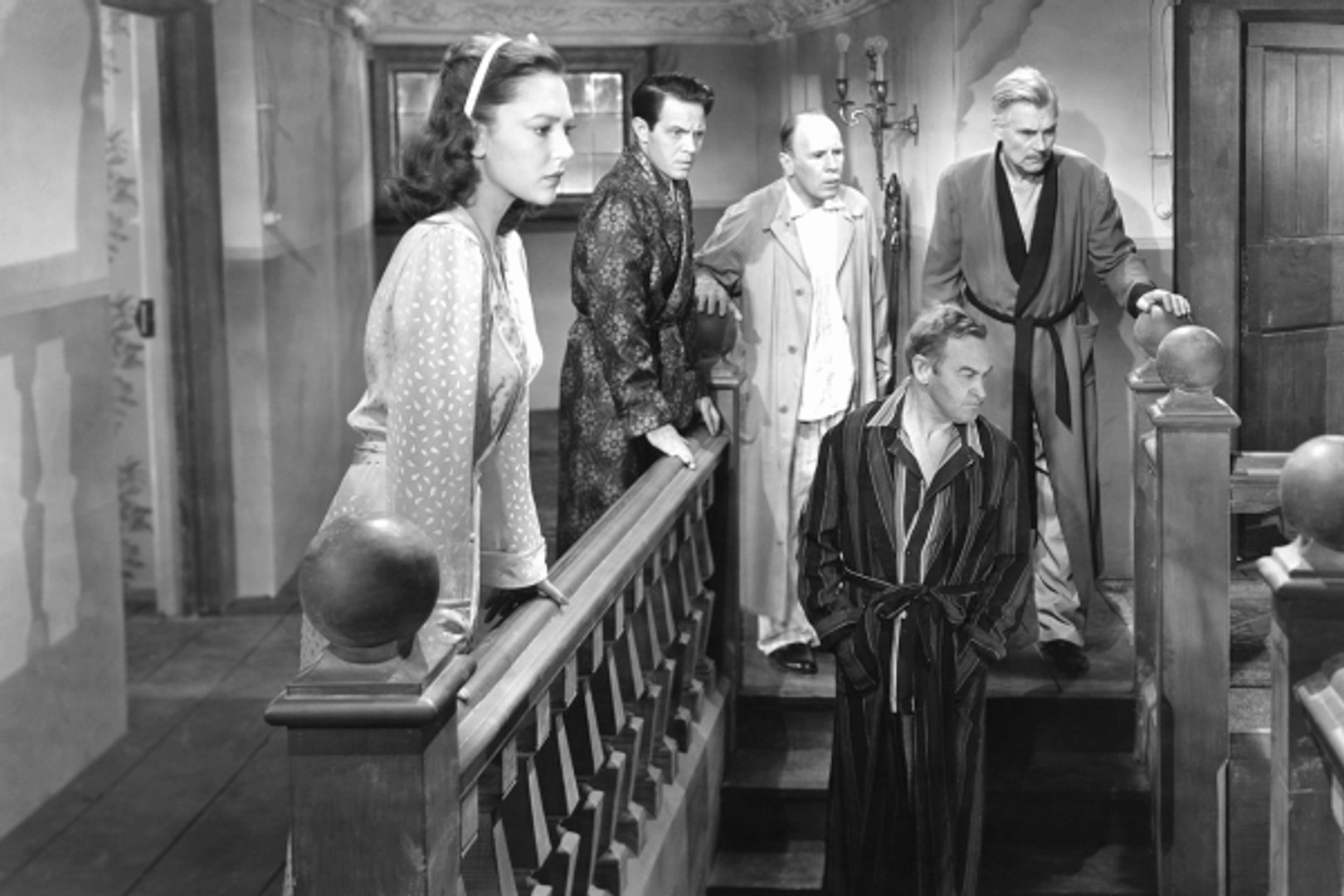
And Then There Were None (1945)


6/10


Starring

Barry Fitzgerald

Walter Huston

Louis Hayward


Directed by René Clair


I saw the 2015 BBC TV series adaptation first before watching this, and even though both versions kind of remixed the ending, the remix in this 1945 version really messed up the book’s ending for me. The book’s conclusion is masterfully crafted to portray the killer as a sick man whose aim—to punish everyone who escaped the law—was successful. In this movie, however, he’s still a sick man, but his aim to punish everyone was unsuccessful.

The story is based on one of the most (if not the most) successful mystery thrillers written by Agatha Christie: And Then There Were None (1939). The plot is framed around the nursery rhyme Ten Little Indians (though Christie originally released the book as Ten Little Niggers).

For me, the movie fails to tick all the boxes of a masterpiece. The pacing lost me at times, with moments of boredom in between. The acting was top-notch, but in such a tense life-or-death situation, the romantic tension between characters felt forced. The cinematography wasn’t the best I’ve seen, but it was good enough to carry the movie from start to finish.

The plot begins with eight people arriving by boat on an island, all invited by a certain Mr. Owen—a man none of them has met. On the island, they’re greeted by a couple, Mr. and Mrs. Rogers, who were hired by Mr. Owen to care for the guests. Mr. Rogers plays a record at a specified time, per Owen’s instructions, and the voice on the recording accuses all ten people in the room of crimes that led to someone’s death. They soon realize there’s no way off the island until the boat that brought them returns. Now, they’re trapped and forced to confront the accusations while trying to survive.

At the dining table, the group notices ten figurines representing the Ten Little Indians rhyme. One guest recites the rhyme, while the others lounge about, wondering why they’ve been brought here and realizing none of them actually knows Mr. Owen. After one guest plays the Ten Little Indians tune on the piano, he takes a drink and dies from poisoning. The group moves his body and discovers that one of the figurines is missing. To their horror, his death mirrors how one of the "Indians" in the rhyme dies.

One by one, the remaining guests start dying in ways that correspond to the rhyme, leaving the survivors to figure out who among them is orchestrating these killings—and how they can stay alive.

It’s a decent film, but the romantic subplot between two of the characters felt unnecessary, and the movie’s altered ending left me preferring the 2015 BBC adaptation.

Rope (1948)

Rope (1948)


7/10


Starring

James Stewart

John Dall

Farley Granger

Joan Chandler


Directed by Alfred Hitchcock


Rope is an artwork directed by the late, great Alfred Hitchcock. The movie is set in real time, giving it the feel of being done in one continuous take (though it’s actually composed of several segments filmed this way). Its artistry earns applause not just for Hitchcock but also for editor William H. Ziegler. Rope dives deep into the mind of someone truly rotten to the core. With its brilliant narrative, it stands out as a satisfying crime thriller about two men attempting to commit the perfect murder.

The film is an adaptation of a 1929 play of the same name and is one of Hitchcock’s first to be shot in Technicolor. It features fantastic acting that’s better experienced than described: the overwhelming confidence of Brandon (John Dall), the shakiness of Philip (Farley Granger), and the intellectual assertiveness of Rupert (James Stewart).

The story begins with Brandon and Philip murdering a man named David. You might think they’d dispose of the body or take some reasonable next steps, but instead, Brandon decides to show off while Philip would rather flee. Brandon hides the body in a table, sets up a buffet on top of it, and invites guests over: Janet (David’s girlfriend), Kenneth (Janet’s former boyfriend), Rupert (the housemaster of Brandon, Philip, David, and Kenneth), and two others.

Brandon has a bizarre plan: to survive the evening without anyone discovering David’s body and to impress Rupert. Rupert, known for his philosophical musings about crime, has been noted for saying that murder is a crime for most men but a privilege for the few.

The film focuses on Brandon’s attempt to get away with the “perfect” crime while the body lies hidden right under the noses of David’s acquaintances. Meanwhile, Rupert gradually pieces together what’s going on, guided by his intuition and observations of Brandon and Philip.

The dialogue could use some fine-tuning, and the single-location setting creates a sense of confinement that might feel limiting to some. Still, Hitchcock deserves praise for his ambitious approach. While the editing is impressive for its time, it feels like a modern production could elevate it even further. What truly pushes this film over the top is the acting—both from the leads and the supporting cast. Their performances compensate for many of the movie’s shortcomings and make it a must-watch.

There’s a peculiar, tense sexual dynamic between Brandon and Philip, which feels more intentional than coincidental. Kenneth even comments on how Brandon used to hang on Rupert’s every word. At the time of its release, the movie didn’t attract enough viewers to become a hit.

However, I still believe Rope is one of the lesser-celebrated masterpieces of the storytelling genius, Alfred Hitchcock.

The Third Man (1949)


The Third Man (1949)


8/10


Starring
Joseph Cotten
Alida Valli
Orson Welles
Trevor Howard


Directed by Carol Reed


The musical theme of this movie is something that’s well known, and the overall musical score can best be summarized in one word: classic. The movie itself pulls at the strings of your heart and senses from different angles.

In summary, the movie is about the death of Harry Lime (Orson Welles), which is weird because the accounts of his death don’t match. One witness saw three men carry Harry’s body, but according to the police report based on two witnesses, there were only two men there.

The person who discovers this inconsistency is Harry’s friend from America, Holly Martins (Joseph Cotten). Holly is visiting Vienna—the place where the movie is set—for a job promised to him by Harry. Upon arriving in Vienna, he hears of Harry’s death and attends the funeral. When Holly starts to investigate what happened to his friend, his path crosses with the officer in charge of the case, Major Calloway (Trevor Howard).

Holly wants to get to the bottom of the case and see what the police are missing or hiding because the Harry he knew growing up isn’t the same Harry the police are glad is dead. At this point, you wish you had a friend like Holly on your side. But that changes quickly as the movie develops, and later on, you wish you never had a friend like him. His way of trying to solve the case leads to many other people getting into trouble, while he gets off unscathed—though out of breath from running for his life. Then there’s Anna, Harry’s love interest. Her place in the movie is everywhere, and this thriller plays with these three characters in ways that make you wonder how the movie plans to wrap everything up.


You keep watching to find out what really happened to Harry. Who are these men who carried him to the sidewalk when he died? Did he die immediately, or did he live long enough to leave a message for Holly and Anna? Was Harry as bad as the police say, or was there a cover-up? Watch this wonderful movie to get the answers to these questions.

The movie has some very unusual camera angles. The cinematographer shot some scenes at angles that make you wonder if it was an error, but then it happens so often that you start to like it.

Seen as one of the best movies ever—which I agree with—the acting in this movie will leave you gasping for more and wishing the movie had more to offer. But it ends with your mind left to wonder how Holly and Anna will deal with the aftermath of Harry.

As much as I stand that this is a must see, I must also point out that the movie doesn’t help itself with the convoluted plot twist, which can feel forced. The pacing can be uneven, especially in the dialogue-heavy scenes that dull the tension. Some of the supporting characters feel underdeveloped, just serving as plot devices. And while Orson Welles’ performance as Harry Lime is iconic, I think the character’s motivations are a bit unclear.


The Treasure of Sierra Madre (1948)


The Treasure of Sierra Madre (1948)


7/10


Starring
Humphrey Bogart
Walter Huston
Tim Holt
Bruce Bennett


Directed by John Huston


This was a better outing by John Huston. I much prefer this movie to his 1941’s The Maltese Falcon. Huston has made many great movies, with many tagged as classics, and this one is just as deserving of the term "classic."

What I liked about this movie is the irony that Howard (a character played by John Huston’s father, Walter Huston) sees in it. It’s like they went full circle and ended up where they started, but this time, two of them have a better idea of how they’ll live their lives from now on.

What makes this movie fantastic is watching it without having read the book it’s based on. John Huston wrote the screenplay and directed the movie, adapting it from a 1935 book of the same name by B. Traven.

The movie’s plot can be summarized in one sentence: You should never say never, and money brings out the worst in us. This theme is there from the start, but money just brings it out into the open.

We meet Dobbs (Humphrey Bogart), living in 1925 Mexico, trying to find any job to earn some money to get by. Down on his luck, he begs for money. He runs into another American, Curtin (Tim Holt), and the two talk about how hard things have been for them. A con man hires them to work on a site for him, but when they finish, he refuses to pay them and runs away.


The time it takes to get to this point in the movie might make you think the above is a spoiler, but it’s not.

They use their last cash to get a decent bed at what can best be described as a flophouse. There, an old man named Howard tells tales of gold. Dobbs gets interested but doesn’t have the money to fund the expedition. The next day, the lucky two run into the man who cheated them out of their pay. They track him down and manage to get their money. They use that money, along with some Dobbs luckily comes into, to board a train and go searching for gold dust.

Their train is attacked by bandits, who later play significant roles in the remainder of the movie.

The trio gets lucky, but the time they spend together gathering gold dust doesn’t do anything good for their minds. It’s these crazy behaviors that the movie is really about.

The movie starts off slow, taking its time before the tension really kicks in. Some of the dialogue feels a bit too long, making certain scenes drag. And while it does a great job exploring greed and paranoia, the descent into madness can feel a little over the top.

Fun, captivating, and interesting. I recommend this movie to anyone who wants to see a good movie take unexpected turns and leave them wondering how things got so out of hand.

The Maltese Falcon (1941)


The Maltese Falcon (1941)


4/10


Starring
Humphrey Bogart
Mary Astor
Gladys George
Peter Lorre
Barton MacLane


Directed by John Huston


Why this movie is regarded as a classic is beyond me. Other than the nice cinematography, I felt the musical score and the plot itself were off. Some of the characters were absurd—their acting was okay, but their roles weren’t.

What’s the love relationship between Spade and O'Shaughnessy? It seemed like it was a checklist item the studio needed to include, not something that was part of the initial plan. I couldn’t understand how they fell for each other; it felt like an afterthought on film.

I’ve seen Humphrey Bogart in other films, and they’re quite enjoyable, but in this one, his character comes off as a lady-killer with no control over his aura. He’s also oddly good at punching—one punch is all he needs to knock people out.

From the moment the Maltese Falcon lands at Spade’s feet to the reason the fat man takes a knife to it without a care, I’ll leave it to you, the viewer, to make sense of it in the context of the general plot. The suspense in this movie is muddled in the writing. While trying to add too much suspense, it ends up being too weak in the thrill department. If I didn’t have control over the screen while watching this movie, I probably would have fallen asleep.


The movie’s plot introduces us to Sam Spade (Humphrey Bogart), a private detective with a chip on his shoulder. His wise-guy actions can come off as annoying and reckless, whether he’s facing a gun or being interrogated by the police. He gets a visit from a woman named O'Shaughnessy, who asks for his help to locate her sister—which turns out to be a lie. That lie leads us down a path where Spade’s partner gets killed. The man (Thursby) she claims ran off with her sister is also killed that night.

The police think Spade killed Thursby in revenge for his partner’s death, but things get awkward when they discover there was something going on between Spade and his partner’s wife. O'Shaughnessy ends up not being truthful, and Spade learns there’s more to this lady than he can figure out.

Then he meets another man named Cairo, who pulls a gun on him and offers him five thousand dollars if he can help find the Maltese Falcon, a priceless item. Soon, we learn that Cairo knows O'Shaughnessy, and there’s another player in the mix. The main focus of the plot is locating the Maltese Falcon and solving who killed Spade’s partner.

The movie was written and directed by John Huston in his directorial debut. It’s said that Huston was meticulous about the screenplay, which was based on a book of the same name by Dashiell Hammett. His planning made shooting the movie easy and on time, never overshooting the budget. If you’re into classics, many have said this is one of them—I just don’t agree.


The Thief of Bagdad (1940)


The Thief of Bagdad (1940)


7/10


Starring
Conrad Veidt
Sabu
John Justin
June Duprez


Directed by Michael Powell, Ludwig Berger and Tim Whelan


The Thief of Bagdad is a 1940 British fantasy film and a classic remake of the 1924 film of the same name. The movie is magical, with each scene inviting you into its world. You’ll love the special effects—that is, if you’re viewing it through the eyes of someone from the 1940s. This is where the whole blue screen effect started, and if you’re like me and enjoyed Disney’s Aladdin, you’ll love seeing where Disney got their inspiration.

It wouldn’t be fair for anyone to list fantasy films and skip this classic. This was one movie I remember watching when I was young, introduced to me by my lovable aunt, who sparked my love for movies. This film made me wish I had a flying carpet of my own. Sabu, who played Abu, didn’t deliver what many consider the classic acting that made him famous, but he wasn’t bad either. For me, the actor who stole the show was Conrad Veidt, who played Jaffar. 

Ahmed, as the lead, doesn’t have much depth, and his journey isn’t as engaging as it could be—especially when Jaffar steals every scene he’s in.


The movie’s plot follows a prince named Ahmed (John Justin), who is tricked by his most trusted advisor, Jaffar, into leaving the palace to experience life on the streets firsthand. While there, Jaffar has Ahmed arrested as a madman and plans to kill him, all while seizing the throne for himself. In prison, Ahmed meets a resourceful thief named Abu, and together they break out of jail.

During their escape, Ahmed meets and falls in love with a beautiful princess—someone Jaffar also has his eyes on. Jaffar does everything he can to get Ahmed out of the way, while Ahmed and Abu team up to save the princess. Their journey includes meeting a genie, acquiring a magic carpet, and finding a crystal that can show them anything they desire.


This British classic used the best special effects of the 1940s and won Academy Awards for Cinematography, Art Direction, and Special Effects. The Thief of Bagdad marks the first major use of bluescreening in the film industry, thanks to Larry Butler, who introduced and pioneered the technique.

The movie has greatly influenced many films that came after it, especially those based on The Book of One Thousand and One Nights tales. Let’s not forget Disney’s Aladdin and its franchise, as well as The Prince of Persia video game series. The film holds a strong 100% approval rating on the critic aggregate site Rotten Tomatoes and was both a critical and commercial success. So, if you haven’t seen this wonderful tale set in Baghdad—about how a prince and a thief take on the evil sorcerer Jaffar to save a beautiful princess—then where have you been? 

Oh, one finally thing, the film leans heavily on spectacle, which makes for stunning visuals, so prepare yourself for that, as it plays like a series of grand set pieces rather than a fully immersive adventure.

Take the time to watch this movie. You’ll be glad you did.


Double Indemnity (1944)


Double Indemnity (1944)


7/10


Starring
Fred MacMurray
Barbara Stanwyck
Edward G. Robinson


Directed by Billy Wilder

The movie is about greed and seduction, with a plot that probably wouldn’t fly in the modern film era. It would likely be ripped apart by forensic evidence and modern detection methods, but in the 1940s, such science wasn’t widely available, so the plot worked just fine. The movie does not try to get away with things it could not control.

The story follows an insurance salesman (Fred MacMurray) who gets lured—quite easily, due to his greed—into an insurance fraud scheme. The plan seems simple to him: all he has to do is kill the husband of the woman he desires and make it look like an accident. Meanwhile, he tricks the husband into signing an accident insurance policy that leaves everything to his lady friend. That way, he gets the girl—and with her, the money.

The movie is best described as nice and has become a classic over time. Double Indemnity is beautiful and captivating, based on a 1943 novel of the same name by James M. Cain. This film was the pinnacle of 1940s film noir and inspired many copycat B-movies from other producers.

The screenplay was written by Billy Wilder, who also directed the movie. The way the story unfolds makes you appreciate the screenwriter’s work. While watching, I was on the edge of my seat, eager to find out if they would get away with it or not. Fred MacMurray narrated and starred in the film. Although it was a huge critical success and was nominated for seven Academy Awards, it didn’t win any. Still, Billy Wilder’s writing and direction in this movie are a masterpiece worth treasuring and a work of art worth owning.

The movie (and the book it’s based on) revolves around the double indemnity clause in life insurance or accident policies. This clause states that the insurance company agrees to pay double the face amount in the contract if the death is caused by accidental means. I liked the cast in this movie, they delivered memorable performances that still lives rents free in my brain.

The film was a box office success, making over five times its production cost. It also popularized the use of "venetian blind" lighting in its cinematography, which became a staple in later film noir. Double Indemnity was well-received by the American Film Institute (AFI). In AFI’s 100 Years…100 Movies (10th Anniversary Edition), it was ranked 29th, and it earned several other AFI recognitions.

The movie does have drawbacks though, one of which is how Walter Neff falls into the scheme a little too easily, making his descent into crime feel less like a struggle and more like a foregone conclusion. Some twists, though effective in their time, might seem predictable now.

This movie is wonderful. If you haven’t seen or heard about it, now you have—so go watch it!


The Mark of Zorro (1940)


The Mark of Zorro (1940)


7/10


Starring
Tyrone Power
Linda Darnell
Basil Rathbone


Directed by Rouben Mamoulian

One thing this movie has is impressive horse-riding chase scenes that make you grin at the ingenuity of the director and the cinematographer. The film’s pace is so exciting that you can’t help but tip your hat to how it was captured on celluloid.

Basil Rathbone (famous for playing Sherlock Holmes in the Rathbone/Bruce series, which included 14 movies between 1939 and 1946) is a renowned Hollywood swordsman. I also read that Tyrone Power was skilled with a sword, so I eagerly waited for the duel scene between the two.

When the duel finally began, the fact that it was actually the actors wielding the swords—not just stuntmen—added to the excitement. The duel is nothing short of wonderful and masterful. The grace and speed these two expert swordsmen displayed on screen is something I’ll always remember, and I highly recommend others watch it. To this day, I haven’t seen better fencing.

The movie is full of scenes that jump out at you. There’s another chase scene where Zorro (Tyrone Power) makes his horse leap off a bridge into a stream, then swims to shore. It was such a sight that I raised my brow in amazement, wondering how many takes the director needed to get that scene just right.

The Mark of Zorro is a lot of fun, even if you can pick out plot holes and wonder how the hero planned to achieve anything in the riot-like ending. Still, the movie is enjoyable from start to finish. The story is based on The Curse of Capistrano, written by Johnston McCulley in 1919. The book introduced the masked hero Zorro, who is similar to Robin Hood in many ways. Set in Southern California during the early 19th century, the plot follows Don Diego Vega/Zorro (Tyrone Power), who returns home to find his town being extorted by the Governor and his henchman, Captain Esteban Pasquale (Basil Rathbone).

Diego then becomes the masked vigilante Zorro to defend his people from the corrupt Governor’s grip.

The Mark of Zorro is a true oldie. The score, in my opinion, is a bit obvious and doesn’t blend seamlessly with the movie, though it did earn an Academy Award nomination.

The Mark of Zorro is worth watching, even if it’s just to see the duel between Power and Rathbone. I read about it, and it was one of the reasons I sat through this movie.


Miracle on 34th Street (1947)


Miracle on 34th Street (1947)


7/10


Starring
Maureen O'Hara
John Payne
Natalie Wood
Edmund Gwenn


Directed by George Seaton


The movie starts with a note that it might just be one of those feel-good films with no special twist. But as it goes on, you realize that it is exactly that—yet what you won’t expect is the tons of laughs and excitement it packs. All you have to do is hang on until you get to the court scene. From there, right down to the last scene where Kris Kringle appears, I couldn’t help but laugh all the way through.

Miracle on 34th Street is based on a screenplay by George Seaton, who also directed the film. Surprisingly, it was released in May 1947 instead of during the Christmas season, even though it’s a Christmas movie. The movie is well-acted, and the screenplay isn’t bogus or too out of place. Unlike what I initially thought from the title, there’s no single extraordinary miracle to convince everyone that Kris is Santa. Instead, the movie takes a logical approach to prove his claim, though the ending does leave you with a hint of something miraculous. The movie's pacing is slow at first, making the buildup to the courtroom scenes feel sluggish. Then I feel the logical approach to proving Kris's identity, which is refreshing, but it removes that sense of wonder a Christmas movie typically thrives on.

The story begins at the Macy's Department Store Thanksgiving Day parade. The Santa meant to lead the parade shows up drunk, so Doris Walker (Maureen O’Hara), the lady in charge, decides to replace him with a kind, funny-looking old man named Kris Kringle (Edmund Gwenn).

Kris does such a great job that Doris hires him to be Macy’s Santa. While working there, Kris starts something special: he helps parents find toys that Macy doesn’t even sell, which brings the store into the limelight.

Kris also has a personal mission: to make Doris and her daughter Susan (Natalie Wood) believe that he really is Santa. Along the way, things take a turn, and Kris is declared psychologically incompetent, nearly getting institutionalized. Thankfully, Fred Gailey (John Payne), a friend who has his eye on Doris, steps in to help him out.

20th Century Fox’s decision to release the movie in May instead of December paid off at the box office, also it was well-received by critics and won Academy Awards for Best Actor in a Supporting Role (Edmund Gwenn), Best Writing, Original Story (Valentine Davies), and Best Writing, Screenplay.

The film was revisited in 1994 by John Hughes. While the 1994 version (starring Richard Attenborough, Mara Wilson, and Elizabeth Perkins) wasn’t as much of a critical success as its predecessor, it’s just as popular as the 1947 original.

This is a great movie to watch with the family on a cozy Christmas day—or any day, really.


Sherlock Holmes and The Secret weapon (1943)


Sherlock Holmes and The Secret weapon (1943)


6/10


Starring
Basil Rathbone
Nigel Bruce
Lionel Atwill


Directed by Roy William Neill

Good movie, worth seeing and enjoyable acting. Starting with a side of Sherlock that we don’t really get to see much of in the other films of the Basil Rathbone and Nigel Bruce series, Holmes disguises himself in order to fool the Gestapo and escape from Switzerland to London. With him is a scientist, Dr. Franz Tobel. Later in the film, he also uses disguises to get his way around. These acts make Rathbone’s performance more pronounced, as his acting in this movie is top-notch.

The film keeps you hooked with suspense, though the pacing drags at times, making you eager to see where it all leads. The problem is, much of that suspense ends in a predictable way—but in the long run, it doesn’t really matter. 

This is the fourth in the Basil Rathbone/Nigel Bruce series of Sherlock Holmes films, which are based on the characters created by Sir Arthur Conan Doyle.
The movie is credited as an adaptation of Sir Arthur Conan Doyle's Sherlock Holmes tale The Adventure of the Dancing Men, but throughout the movie, the only element that can be said to be taken from the tale is the dancing men code, which Tobel draws to be given to Holmes.

In this film, Lionel Atwill appears as Professor Moriarty, but he previously appeared in the first film of the Rathbone/Bruce Sherlock film series, The Hound of the Baskervilles (1939), as Dr. Mortimer.

The movie’s plot is about a scientist, Dr. Franz Tobel, who invents a bombing device called a bombsight. Sherlock smuggles him into London so he can deliver the invention into the hands of the British.

But Tobel is wanted by the Germans, who are ready to do anything to get their hands on either Tobel or his invention. Professor Moriarty (who seems to be on the Germans’ side because of the financial gain he’ll get) decides to kidnap Tobel and then find the invention, which Tobel has divided into four parts and given to four different people.

The chase then begins between Sherlock and Moriarty—Sherlock looking for the parts and Tobel, and Moriarty looking for the parts too, as he has Tobel, who refuses to bend even under torture.

Sherlock Holmes and the Secret Weapon is a nice watch, and you’ll enjoy the acting put together by the trio of Basil Rathbone, Nigel Bruce, and Lionel Atwill. I believe the movie is free to download and is in the public domain, so check archive.org.

Dressed To Kill (1946)


Dressed To Kill (1946)


6/10


Starring
Basil Rathbone
Nigel Bruce


Directed by Roy William Neill

Dressed to Kill is the final and fourteenth film in the Basil Rathbone and Nigel Bruce Sherlock Holmes film series. The movie is based on the characters created by Sir Arthur Conan Doyle, and although the plot is an original screenplay, it features references to Conan Doyle’s "A Scandal in Bohemia." It’s a fitting nod to the source material, blending originality with Doyle’s classic touch.

The movie’s plot is quite interesting, as everything revolves around a few musical notes that are out of place in a song. The music itself is a message, and figuring out what the message means—or what it’s meant for—is the challenge our duo has to solve. It’s a clever premise, but the pacing can be uneven, especially in the middle.

The story centers on three cheap musical boxes, each playing a subtly different version of "The Swagman." Only someone with a keen ear and a musical background can pick up the differences. The musical boxes were manufactured in Dartmoor Prison by one of its inmates and sold at a local auction house. This quirky detail adds a layer of intrigue to the mystery.

A criminal gang intended to get the boxes but arrived at the auction too late. All three boxes were sold to different owners. However, the gang is determined to recover them by any means necessary, even if it means committing murder. Their desperation sets the stakes high.

Sherlock Holmes is called in when a murder occurs and a musical box appears to be the target. He must recover the last of the musical boxes and crack the secret code contained in the tune before the gang can. It’s a race against time, and Holmes, as always, is at his sharpest.

Food for thought: In the movies, Dr. Watson is portrayed as much older than Holmes, and he certainly looks it—Nigel Bruce appears to be about 10 years older than Basil Rathbone. But in real life, Rathbone was actually three years older than Bruce; Bruce just looked older. There’s been much discussion about the portrayal of Watson in this series, as he’s depicted as a bumbling fellow who doesn’t really contribute to Sherlock’s detective abilities. In contrast, in the books and subsequent remakes of Conan Doyle’s characters, Watson is portrayed as an upright and necessary addition to Holmes’ detective work. It’s a shame, really, because Watson deserves better.

Dressed to Kill is a good movie to watch, as it shows our protagonist staying one step ahead of everyone else. We see him pickpocket with ease and escape death with the ingenuity of a fox. The movie is a nice ending to a wonderful pair and a fantastic film series. It’s a bittersweet farewell to Rathbone and Bruce’s iconic portrayals.

Terror by night (1946)


Terror by night (1946)


6/10


Starring
Basil Rathbone
Nigel Bruce


Directed by Roy William Neill

Terror by Night is the thirteenth film in the Sherlock Holmes series starring Basil Rathbone and Nigel Bruce, directed by Roy William Neill. It’s based on the characters created by Sir Arthur Conan Doyle, and although the movie’s story is original, it borrows plot elements from some of Doyle’s Sherlock Holmes mysteries, including The Adventure of the Empty House, The Disappearance of Lady Frances Carfax, and The Sign of the Four.
The movie has more twists and turns than a doorknob. Just when you think things are going one way, the writer (Frank Gruber) takes you on another turn. Shot mostly on a train set, I have to give kudos to the cinematography—at no point in the movie do you feel any sense of cramped shots. The screenplay is also impressive; the twists are so frequent that the writer had to be at the top of his game to avoid leaving too many loose ends and confusing the viewers.
Then there’s the obvious switch Sherlock makes when he’s shown the diamond. You’ll notice the switch, and at first, I wondered why they made it so noticeable. Little did I know it was all part of a bigger plot.
The movie’s plot revolves around a diamond so valuable that the owner’s son hires Sherlock Holmes to guard it while it’s being transported to Scotland by train. During the journey, the diamond is stolen, and a murder is committed. Since the train is still in motion, it’s clear that the murderer is still on board. Now, Holmes and Watson must find the culprit before the train reaches its final stop.
The movie does show a sort of lack of emotion in the character of Lady Margaret. While this was part of the plot and even commented on by other characters, it didn’t sit well with me as a viewer. Also, while death is expected at some point, the death of Roland was a turn-off for me—it was completely unexpected.
The movie’s twists and turns are worth seeing. Although it’s not as captivating or as fun as Pursuit to Algiers, it does showcase good writing and direction from Frank Gruber and Roy William Neill.
It’s a nice DVD to add to your collection.

What I love most about this film is how it keeps you guessing until the very end. The confined setting of the train adds a layer of tension, making every interaction feel charged with suspicion. Rathbone’s Holmes is as sharp as ever, and Bruce’s Watson provides just the right balance of humor and loyalty. While not perfect, it’s a solid entry in the series, blending mystery, suspense, and a touch of that classic Holmes charm. If you’re a fan of clever whodunits, this one’s worth the ride.


Pursuit to Algiers (1945)


Pursuit to Algiers (1945)


7/10


Starring
Basil Rathbone
Nigel Bruce


Directed by Roy William Neill

Pursuit to Algiers is the 12th Basil Rathbone and Nigel Bruce Sherlock film, and it’s based on Sir Arthur Conan Doyle’s characters. The movie is noted to have taken some characters and elements from Conan Doyle’s The Adventure of the Red Circle.

The movie’s plot is quite ingenious, as it takes you by surprise in the way things unfold. Sherlock proves to be a mastermind genius, from the way he disguises the King to how he gets himself on the boat after sending Dr. Watson ahead.

Most of the movie is shot in a boat setting, and it even ends on the boat, which allows for some nice cinematography, but the confined boat setting, limits the action and makes certain moments feel repetitive. The plot shows a little of what many people think Sherlock is—a guy who’s just too smart for the rest of us. Before this was The Woman in Green (1945), also directed by Roy William Neill, who actually did a better job here than he did in The Woman in Green.

The screenplay was done by Leonard Lee, who did a great job ensuring that every moment you spend watching this movie builds anticipation. But while the plot is engaging, the pacing slows in the middle, making some scenes feel drawn out, and the movie's use of Watson as comic relief didn't help to living up the slow moments.

The movie’s plot starts with our duo planning a vacation to take a break from the unending cases they seem to be swamped with. But a series of fortunate events begins to happen on their way home. Sherlock deduces from these events that he’s being called for a meeting.

After solving the events to figure out the address (which was basic elementary, if I do say so myself) and the time of the meeting, he attends and is given a task, which he accepts.

The task is given to him by the prime minister of the fictional country of Rovinia, who begs Holmes to escort Prince Nikolas back to his homeland. It turns out that Nikolas’s father has been assassinated, and Nikolas is next in line to be king. However, since he left the country at birth to be raised in England, no one but the prime minister and a few others know what he looks like. The assassins who killed his father will stop at nothing to kill Prince Nikolas.

The movie is a nice watch—one of those films you see and then gather your friends around to watch with you, telling them there’s something at the end they’ll never guess. It’s a great addition to anyone’s movie collection. The ending joke, where Sherlock tells Watson that he should never take up a career as an actor because he’s bad at it, is a fun touch. Sherlock adds that this is why he sometimes has to keep things from Watson.


The Woman In Green (1945)


The Woman In Green (1945)


5/10


Starring
Basil Rathbone
Nigel Bruce


Directed by Roy William Neill


The Woman in Green is actually a bit dull. The plot is straightforward, but the direction and the story itself just aren’t good enough to fully appreciate. The movie features Sherlock Holmes’ arch-enemy, Professor Moriarty, who is supposed to be Holmes’ intellectual equal. But in this flick, he comes off more like a struggling villain trying to live out a fantasy of being the man to finally kill Holmes.

The Woman in Green is a 1945 American crime drama thriller starring Sir Arthur Conan Doyle’s detective Sherlock Holmes, his faithful companion Dr. Watson, and Professor Moriarty—all characters created by Doyle. It’s the eleventh film to star Basil Rathbone and Nigel Bruce as Sherlock Holmes and Dr. Watson, respectively. The movie isn’t directly based on any of Doyle’s stories, and while it’s credited with having an original screenplay, several scenes feel lifted from The Final Problem and The Adventure of the Empty House.

The plot starts with a string of random murders of women, each having their forefingers severed. These gruesome acts make Scotland Yard think a serial killer is on the loose, and Sherlock is called in to help. During his investigation, he and Watson stumble upon a clue after a deceased man’s daughter brings them a forefinger believed to belong to one of the victims.

Sherlock deduces that something bigger is at play here—not just a random serial killer. His obsession with the idea that Moriarty isn’t dead leads him to conclude that Moriarty is behind the murders. His belief is confirmed when Moriarty himself pays him a visit. Sherlock gets another lead when a man is sent to kill him but seems completely unaware of what he’s doing.

While owning the entire Rathbone/Bruce series would be a nice addition to any movie collector’s shelf, I won’t stop you from adding this one. But, as I said, it’s a low point for me. The excitement I felt watching The Hound of the Baskervilles (1939) kind of vanished halfway through this one. This post-World War II movie feels a little dry for my taste, and while it has its moments, it doesn’t quite live up to the charm and intrigue of other films in the series.

What really bugged me was how predictable some parts felt. Even the big reveal lacked the punch I expected, and Moriarty’s grand plan felt underwhelming. Still, if you’re a die-hard Holmes fan, you might find some enjoyment in it—just don’t go in with high expectations.

The Adventures of Ichabod and Mr. Toad (1949)


The Adventures of Ichabod and Mr. Toad (1949)


7/10


Starring the voice of
Eric Blore
Pat O’Malley


Narrated by Basil Rathbone, Bing Crosby and Sterling Holloway

The Adventures of Ichabod and Mr. Toad is a 1949 animated feature produced by Walt Disney himself. It consists of two segments: one based on Kenneth Grahame's 1908 children's book The Wind in the Willows, and the other based on The Legend of Sleepy Hollow, a short story by Washington Irving from his collection The Sketch Book of Geoffrey Crayon, Gent.

The Adventures of Ichabod and Mr. Toad is the 11th animated feature in the Walt Disney Animated Classics series. At the time, Disney had shifted from making full-length animations to producing short package films due to America's involvement in World War II. The war led to some of Disney's animators being drafted, and the high cost of creating full-length features made package films a more practical option. A total of six package films were released during this period: Saludos Amigos, The Three Caballeros, Make Mine Music, Fun and Fancy Free, Melody Time, and finally, The Adventures of Ichabod and Mr. Toad.


To attract viewers, Disney cast Basil Rathbone (famous for playing Sherlock Holmes) and Bing Crosby as narrators. The movie stays quite faithful to the stories it adapts. In Mr. Toad's segment (narrated by Basil Rathbone), the charismatic J. Thaddeus Toad, Esq., is willing to do anything to satisfy his obsession with adventure, even if it means giving up everything and landing himself in trouble over a stolen motorcar. The Legend of Sleepy Hollow (narrated by Bing Crosby) follows Ichabod Crane and the Headless Horseman. Ichabod's selfish desire to marry Katrina Van Tassel and claim her father's wealth puts him at odds with the town bully, Brom Bones, who ultimately scares Ichabod away with tales of the Headless Horseman—a figure Ichabod later encounters.

Interestingly, both The Wind in the Willows and The Legend of Sleepy Hollow were initially planned as full-length animations. Work on The Wind in the Willows began in 1941 but was halted during the war and later reworked into a short film, though it waited for a suitable pairing. Production on The Legend of Sleepy Hollow began in 1946, but when Disney realized how short the film would be, they decided to pair it with The Wind in the Willows and release them together under the title The Adventures of Ichabod and Mr. Toad.

While both segments are entertaining, I feel the film’s biggest weakness is its uneven pacing. Mr. Toad’s story moves quickly, sometimes feeling rushed, while Ichabod’s segment takes its time but drags in places. Plus, the characters, while charming, aren’t as deeply developed as in other Disney classics, making it harder to connect with them.

The movie has received critical acclaim and remains an enjoyable watch for both adults and kids. There’s no heavy moral lesson here—just good old-fashioned cartoon fun.

Casablanca (1942)


Casablanca (1942)


8/10


Starring
Humphrey Bogart
Ingrid Bergman
Paul Henreid


Directed by Michael Curtiz

Here is a movie that has always found a way to remain at the top of the lists when it comes to the best movies ever made.

Casablanca crosses the genres of drama and romance. The acting is top-notch, and the movie’s screenplay is so well done that you’ll be torn in two for Ilsa. Humphrey Bogart (Rick) was the perfect prince charming and also a hero in every way, including love. Must add, the love story is very predictable.

Made in 1942, Casablanca is based on an unproduced play named Everybody Comes to Rick's by Murray Burnett and Joan Alison.

The movie’s ending is one that I love and something you can rewind to watch again. The dramatic scene, which shows sacrifice, love, and suspense, is unforgettable. The twist at the end is something the producers slipped in to catch the audience off guard, and it's something I really enjoyed. The main issue with the movie for me was its pacing, it at times seem to drag when it needed not to.

Casablanca’s lines (“Here’s looking at you, kid” and “Louis, I think this is the beginning of a beautiful friendship”) have remained on the lips of many and have been fondly repeated in more movies than I can bet the producers ever dreamed.

So, what is this great movie about?

Casablanca’s plot is set during the early years of World War II. In Casablanca (Morocco), there is a man named Rick Blaine (Humphrey Bogart) who owns the most popular hangout spot in the city. He has everything under control and even has influence over the police. Everything is fine until the past comes knocking.

Ilsa Lund (Ingrid Bergman), an old lover of Rick, shows up at Rick’s nightclub, and sparks fly in both directions, as they lost contact (her fault) without any explanation.

Ilsa isn’t alone; with her is her husband, Victor Laszlo (Paul Henreid), a renowned fugitive Czech Resistance leader.

The couple needs letters to escape to America—letters only Rick can give. So Rick is in a dilemma: help the woman he loves escape with her husband, or keep her in Casablanca.

Nominated for eight Academy Awards, Casablanca went home with three: Best Picture, Best Director, and Best Adapted Screenplay. The movie was a commercial success and has a strong cult following, which has hindered any plans for a sequel or the colorization of the film.

The movie’s cinematography was done by the same cinematographer from Frankenstein (1931), who made sure that every time we see Bergman, her eyes sparkle.

Casablanca is ranked 3rd on AFI's 100 Years... 100 Movies (10th Anniversary Edition). I highly recommend you experience Casablanca, an iconic movie that sets the trend for what a true romantic movie should be about.

Disclaimer

All images featured on this site are the property of their respective copyright owners. They are used solely for illustrative and commentary purposes under fair use principles. This site is a personal blog, unaffiliated with or endorsed by any copyright holders. If you are the copyright owner of an image featured here and wish to have it removed, please contact me directly, and I will address your request promptly.